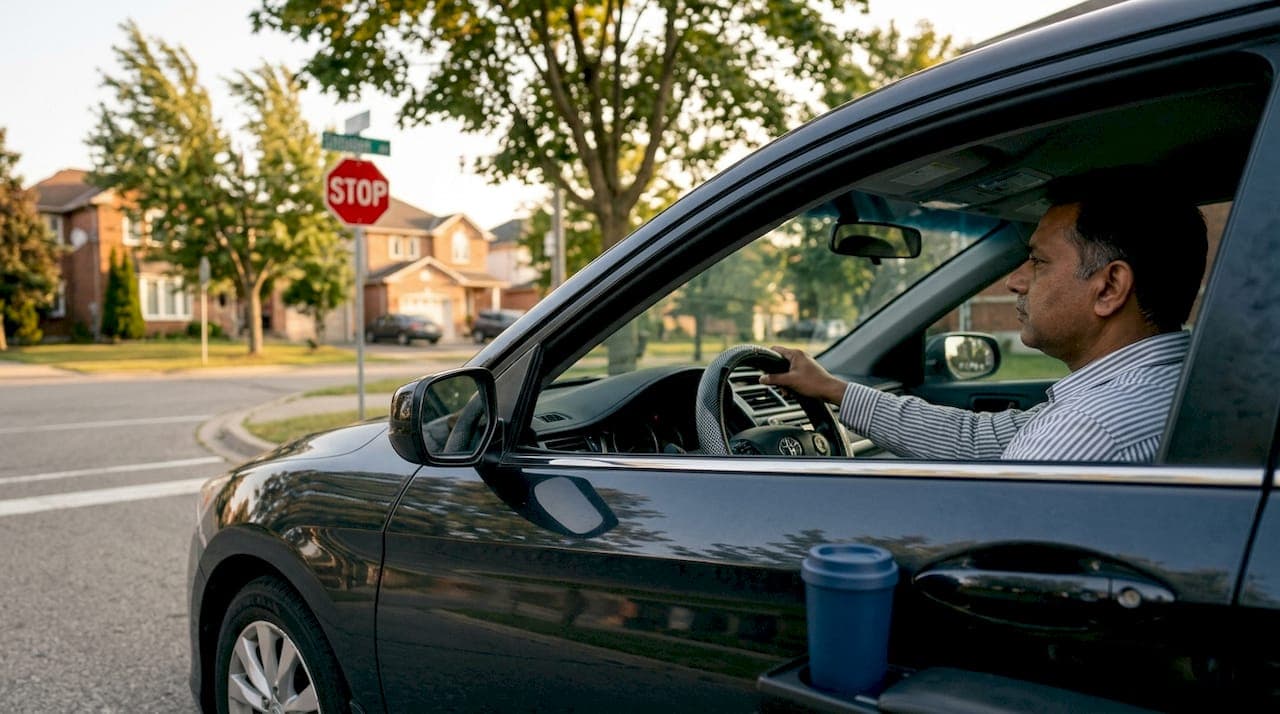
Failing to stop at a stop sign in Ontario is a Provincial Offences Act violation that carries a $110 fine and three demerit points upon conviction. Most drivers treat it as a minor annoyance and pay the fine without realizing that payment is a guilty plea. That guilty plea lands on your driving record, triggers an insurance premium increase, and cannot be undone. Understanding the legal definition of a complete stop, the full scope of penalties, and your options to fight the charge puts you in a far stronger position.
What counts as failing to stop at a stop sign in Ontario?
Failing to stop at a stop sign in Ontario means your vehicle did not reach zero velocity before proceeding through the intersection. The legal definition of a complete stop requires zero miles per hour, confirmed by the vehicle's suspension exhibiting a visible rebound. That rebound is the physical bounce a car makes when it fully ceases forward motion. Without it, the stop did not happen in the eyes of the law.
Your vehicle must reach zero velocity before the limit line, the crosswalk, or the entrance to the intersection, whichever comes first. Stopping past the line and then reversing does not satisfy the requirement. The officer must observe your vehicle from a position where the suspension rebound is visible, which is why enforcement often happens at intersections with clear sightlines.

The term "rolling stop" is the common name for what Ontario law treats as a stop sign violation. Slowing to 5 km/h and proceeding feels like stopping to most drivers. Courts do not agree.
Pro Tip: If you stopped beyond the limit line because of an obstructed view, document the exact position of your vehicle and the sightline obstruction immediately after receiving the ticket. That detail becomes a defense argument later.
| Scenario | Legal outcome |
|---|---|
| Vehicle reaches zero velocity before limit line, suspension rebounds | Complete stop. No violation. |
| Vehicle slows but does not reach zero velocity (rolling stop) | Violation. Ticket is valid. |
| Vehicle stops past the limit line or crosswalk | Violation. Position was incorrect. |
| Stop sign obscured by vegetation or signage | Potential defense. Document immediately. |
| Vehicle stops, then proceeds before officer confirms rebound | Likely violation depending on officer's observation angle. |
What are the penalties for a stop sign ticket in Ontario?
The standard fine is $110, but that number is not the ceiling. If you request a trial and the court finds you guilty, the fine can reach $500. Three demerit points are added to your license on conviction regardless of which fine amount applies.
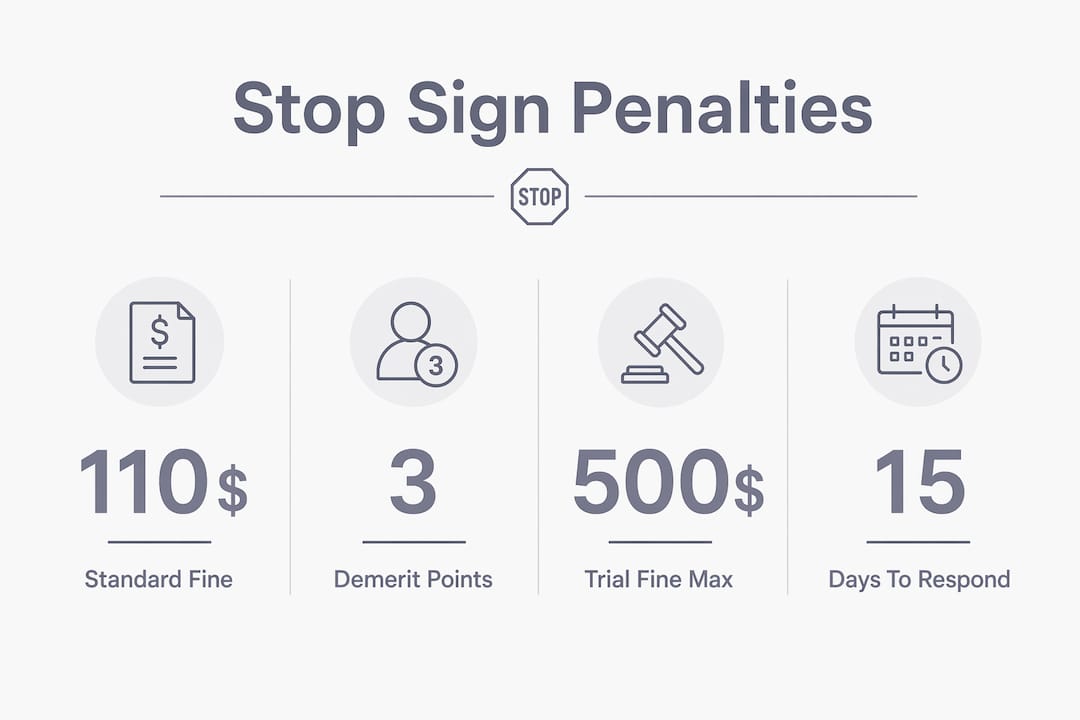
Demerit points stay on your record for two years from the date of the offense. Accumulating six or more points triggers a warning letter from the Ministry of Transportation. Nine or more points can result in a license suspension interview. Drivers under the age of 19 or on a graduated license face lower thresholds, meaning three demerit points from a single stop sign conviction can already trigger ministry action.
The insurance impact is the consequence most drivers underestimate. A conviction for a stop sign violation is a minor conviction under most insurance policies, but insurers in Ontario treat minor convictions as signals of elevated risk. Premium increases of 10–25% are common after a first conviction, and the conviction stays on your insurance record for three years.
- Three demerit points added on conviction
- Fine of $110 if you pay or plead guilty with explanation
- Fine up to $500 if you contest and lose at trial
- Insurance premium increase for up to three years
- Driving record conviction visible to employers and licensing bodies
Ignoring the ticket entirely results in a default guilty conviction. The court enters the conviction automatically. You receive no hearing, no opportunity to negotiate, and no chance to present evidence. The fine, the demerit points, and the insurance impact all follow.
How can you legally contest a stop sign ticket in Ontario?
Three formal options exist when you receive a stop sign ticket: pay the fine and plead guilty, appear in court and plead guilty with an explanation, or request a trial to dispute the charge. The first option closes every door. The second may reduce the fine but still records a conviction. The third gives you the best chance of avoiding a conviction entirely.
You must respond within 15 days of receiving the ticket. Missing that window results in a default conviction with no recourse. The 15-day deadline applies whether you intend to pay, explain, or fight.
The prosecution meeting: the step most drivers skip
Requesting a trial triggers a pre-trial meeting with the prosecutor. Meeting with the prosecutor before the trial date is the single most overlooked step in contesting a traffic ticket. Prosecutors have the authority to reduce the charge, withdraw it entirely, or offer a plea to a lesser offense with no demerit points. Drivers who show up prepared with evidence and a clear argument get better outcomes at this stage than at trial.
Common defenses that carry weight
- The stop position defense. You stopped, but past the limit line because vegetation or a parked vehicle blocked your view of oncoming traffic. The law requires a stop before the line, but courts recognize that drivers sometimes need to creep forward to see. Document the obstruction with photos taken the same day.
- The obscured sign defense. The stop sign was not visible due to overgrown trees, a missing sign, or a sign that had been knocked out of position. Photograph the sign and its surroundings immediately.
- The officer's observation angle. The officer was positioned where a suspension rebound was not clearly visible. This requires cross-examining the officer's notes and testimony about their exact location.
- Requesting disclosure. Before trial, request all evidence the prosecution holds, including the officer's notes, any video from police vehicles, and the officer's training records on stop sign enforcement. Gaps in disclosure can support a dismissal.
Pro Tip: Paying the ticket online immediately records a guilty conviction. Once paid, you cannot contest the charge. Never pay online if you have any intention of fighting the ticket.
What evidence actually wins stop sign cases in court?
The officer's testimony about the suspension rebound is the prosecution's primary tool. Officers rely on the suspension rebound as physical evidence of whether a full stop occurred. Your personal belief that you stopped is not enough to counter that testimony without corroborating proof.
Dashcam footage is the strongest defense evidence available. A recording that shows your speedometer at zero, your vehicle's position relative to the limit line, and the timestamp of the stop gives the court objective data. Courts treat dashcam footage with intact metadata as credible because it is difficult to alter without detection.
- Dashcam footage with metadata intact: Shows zero velocity, exact stop position, and timestamp. This is the strongest single piece of evidence.
- Photographs of the intersection: Taken immediately after the ticket, showing the sign's visibility, the limit line's position, and any obstructions.
- Witness testimony: A passenger who observed the stop can corroborate your account, but the court will weigh their credibility carefully given their relationship to you.
- Officer's notes and disclosure: Gaps, inconsistencies, or missing details in the officer's notes can undermine the prosecution's case.
Minor clerical errors on the ticket rarely help your defense. Courts correct minor errors without dismissing the charge. Only fatal flaws, such as a missing offense date, no location, or no officer's signature, can lead to dismissal. Betting your defense on a spelling mistake is not a strategy.
Pro Tip: Request full disclosure from the prosecutor as soon as you request a trial. Officers sometimes fail to submit notes within the required timeframe. A missing or incomplete disclosure package can support a motion to stay the charge.
Key Takeaways
Failing to stop at a stop sign in Ontario triggers a $110 fine and three demerit points, but contesting the charge with dashcam evidence and a prosecutor meeting gives drivers a real path to avoiding a conviction.
| Point | Details |
|---|---|
| Legal definition of a stop | Zero velocity with suspension rebound before the limit line. Rolling stops are violations. |
| Standard penalty | $110 fine and three demerit points. Fines reach $500 if you contest and lose. |
| Respond within 15 days | Missing the deadline results in an automatic guilty conviction with no appeal. |
| Prosecution meeting | Meeting the prosecutor before trial is the most overlooked and effective step in contesting a ticket. |
| Dashcam footage | Video showing zero velocity and stop position is the strongest defense evidence in Provincial Offences Court. |
What I've learned defending stop sign tickets in Ontario
The drivers who come to me most frustrated are the ones who paid the ticket online the same day they got it. They thought $110 was the cost of a minor mistake. Six months later, their insurance renewal arrives and the premium has jumped. That jump lasts three years. The math rarely favors paying quickly.
The second pattern I see constantly is drivers who request a trial but skip the prosecutor meeting. They show up on trial day expecting to argue their case and discover that a five-minute conversation with the prosecutor beforehand could have resolved everything. Prosecutors deal with hundreds of stop sign tickets. They know which cases are strong and which are not. A driver who arrives with dashcam footage and a clear account of what happened gives the prosecutor a reason to offer a deal.
The myth I hear most often is that stop sign tickets are easy to beat because officers make mistakes. They do make mistakes, but courts are skeptical of defenses built entirely on attacking the officer's credibility without objective evidence. The suspension rebound observation is simple and consistent. Challenging it without dashcam footage or a clear sightline argument is a difficult position.
My advice is direct: if the ticket involves three demerit points and you are already carrying points on your license, get professional help before you respond. The consequences for your license compound quickly when you are close to a suspension threshold.
— Maninder
How Peeltrafficdefence helps you fight a stop sign ticket
A stop sign ticket feels minor until you see what it costs over three years of higher insurance premiums.

Peeltrafficdefence represents Ontario drivers in Provincial Offences Court, handling everything from ticket response to evidence gathering to prosecutor negotiations. The team knows how to read disclosure packages, identify fatal flaws, and build the strongest possible case before trial day. Drivers who work with Peeltrafficdefence protect their driving records and avoid the insurance consequences that follow a conviction. If you received a stop sign ticket and want to know your options, visit Peeltrafficdefence to get started. You can also read what past clients say on the client testimonials page before making a decision.
FAQ
What is the fine for failing to stop at a stop sign in Ontario?
The standard fine is $110. If you contest the ticket and lose at trial, the fine can reach $500, plus three demerit points are added to your license.
Does a rolling stop count as a complete stop in Ontario?
No. A rolling stop does not satisfy the legal requirement. Ontario law requires zero velocity with a visible suspension rebound before the limit line, crosswalk, or intersection entrance.
How long do I have to respond to a stop sign ticket in Ontario?
You have 15 days from the date you receive the ticket. Missing that deadline results in an automatic guilty conviction with no opportunity to contest.
Will a stop sign conviction affect my insurance in Ontario?
Yes. A stop sign conviction is a minor conviction under most Ontario insurance policies and typically triggers a premium increase that lasts up to three years.
Can dashcam footage help me fight a stop sign ticket?
Dashcam footage showing zero velocity, your vehicle's position relative to the limit line, and an intact timestamp is the strongest defense evidence available in Provincial Offences Court.