
Fighting a speeding ticket in Ontario is a legal process governed by the Ontario Provincial Offences Act, and drivers who respond within 15 days of receiving a ticket preserve their right to negotiate, request evidence, or take the case to trial. Paying the fine outright equals a guilty plea, which triggers automatic demerit points and a near-certain insurance premium increase. The good news is that most speeding charges can be reduced or dismissed when you know the right steps. This guide walks you through every stage, from your first response to the courtroom, so you can make an informed decision about your case.
What are your options after receiving a speeding ticket in Ontario?
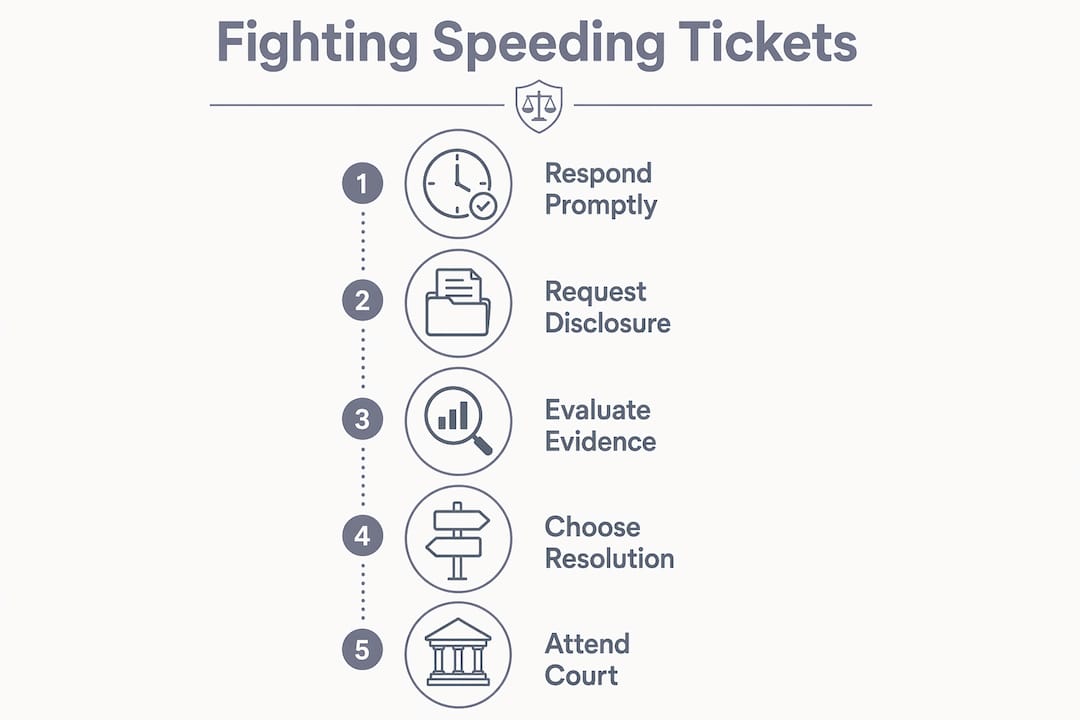
Drivers in Ontario have three choices after receiving a speeding ticket, and the one you pick shapes everything that follows. The 15-day response deadline is the most critical date on your calendar. Miss it, and the court enters an automatic conviction with no appeal and no negotiation.
Your three options are:
- Pay the fine. This is a guilty plea. You accept the conviction, the demerit points, and the insurance consequences. No court appearance is needed, but there is no chance of reducing the charge.
- Request an Early Resolution meeting. You meet with a prosecutor before any trial. Many speeding cases settle here, with charges reduced to lower-point infractions like "disobeying a sign." That reduction alone can prevent a major insurance hike.
- Request a trial. This preserves every defense option available to you. You can challenge the evidence, cross-examine the officer, and present your own case. It takes more time, but it gives you the strongest position.
The Early Resolution route is underused by drivers who assume court is the only alternative to paying. Prosecutors at these meetings are balancing heavy caseloads, which means they often accept a reduced charge rather than prepare for a full trial. That dynamic works in your favor.
Pro Tip: Request a trial even if you plan to negotiate. Once you are in the trial stream, you can still settle at an Early Resolution meeting. Requesting a trial first keeps all your options open.
What evidence should you request to build your defense?
Speeding tickets are strict liability offenses in Ontario. That means the Crown does not need to prove intent. What it does need to prove is that the speed measurement was accurate and legally obtained. Your defense targets the evidence behind that measurement.

The disclosure process is your most powerful tool. You are entitled to request the officer's notes, the radar or lidar device model and serial number, calibration logs, and any maintenance records. Missing or invalid calibration tests can make the speed reading inadmissible. Incomplete officer notes can undermine the prosecution's entire case.
Here is what to look for in the disclosure package:
| Evidence Type | What to Check | Why It Matters |
|---|---|---|
| Officer's notes | Date, time, location, device used | Inconsistencies weaken testimony |
| Radar/lidar calibration logs | Pre- and post-shift tests | Missing tests can void the reading |
| Device maintenance records | Service history and certification | Expired certification invalidates data |
| Officer training records | Certification for the specific device | Untrained use is a valid challenge |
Different speed detection methods carry different technical weaknesses. Radar devices can pick up interference from other vehicles. Lidar requires precise aiming and can misread if the officer's hand moved. Pacing evidence depends entirely on the officer's own speedometer calibration. Each method has a specific angle of attack.
Pro Tip: Submit your disclosure request in writing as soon as you request a trial. The Crown has a legal obligation to provide it, and delays or gaps in the response become part of your defense.
How does the court process work when you fight a speeding ticket in Ontario?
Ontario traffic court follows a structured sequence, and knowing it in advance removes most of the anxiety. The prosecutor presents the Crown's case first, which almost always means calling the issuing officer to testify. Cross-examination then focuses on device calibration, officer training, and the accuracy of the observation.
The court process unfolds in this order:
- Crown opens. The prosecutor calls the officer to give evidence about the stop, the device used, and the recorded speed.
- Cross-examination. You or your representative questions the officer on technical details: calibration dates, device certification, weather conditions, and anything inconsistent with the notes.
- Defense presentation. You can call your own witnesses or introduce evidence. This is where disclosure gaps become arguments.
- Closing submissions. Both sides summarize their positions for the justice of the peace.
- Verdict. The justice delivers one of three outcomes: dismissal, charge reduction, or conviction.
One outcome drivers often misread is the officer no-show. Courts frequently reschedule when an officer is absent rather than dismissing the case outright. Judges have full discretion, and repeated absences are typically required before a dismissal is granted. Building your entire strategy around hoping the officer does not show up is a losing plan.
Pro Tip: Dress professionally and address the justice as "Your Worship." Court conduct affects credibility. A justice of the peace who finds you respectful and prepared is more likely to give weight to your arguments.
When should you hire professional legal help to fight a speeding ticket?
Self-representation works for straightforward cases where the speed was marginal and your record is clean. The calculus changes fast when the stakes go up. Professional representation significantly improves the odds of a favorable outcome in complex or high-impact cases.
Consider hiring a paralegal or lawyer if any of these apply to you:
- The ticket carries 4 or more demerit points. High-point convictions trigger license suspensions and long-term insurance surcharges.
- You are a commercial or novice driver. The consequences of a conviction are more severe, and the threshold for suspension is lower.
- You have prior convictions. A second or third speeding conviction compounds penalties and can put your license at serious risk.
- The charge involves stunt driving. This is a criminal-adjacent offense with immediate roadside suspension and vehicle impoundment.
- You cannot attend court. A licensed paralegal or lawyer can appear on your behalf.
Paralegals who specialize in traffic tickets offer the same courtroom expertise as lawyers for this category of offense, at a fraction of the cost. They know which disclosure gaps matter, which prosecutors negotiate, and which technical arguments have succeeded before the same justices of the peace. For a $500 ticket that could raise your insurance by $2,000 over three years, that expertise pays for itself.
The trade-off between self-representation and professional help comes down to case complexity, potential penalties, and your own comfort level in court. For serious tickets, the investment in professional help is straightforward math.
Common mistakes that cost drivers their case
The single worst mistake is missing the 15-day deadline. Automatic conviction follows immediately, along with demerit points and insurance consequences, with no path to appeal or negotiation. Every other mistake on this list assumes you responded in time.
Avoid these errors:
- Skipping disclosure. Drivers who go to trial without reviewing the officer's notes and calibration records have no idea what arguments are available to them. Disclosure is free and often decisive.
- Assuming the officer will not show. This is not a strategy. Courts reschedule, and you will have wasted a court date with no defense prepared.
- Dressing or behaving casually in court. A justice of the peace notices. Credibility is part of the case.
- Accepting the first offer without reviewing disclosure. Prosecutors sometimes offer reductions that still carry demerit points. A better offer may be available once you know the evidence gaps.
- Waiting too long to request a continuance. If you need more time to prepare, request it early. Last-minute requests are often denied.
Preparation is the common thread behind every successful defense. Drivers who treat the process seriously, respond on time, request disclosure, and show up ready tend to get better outcomes than those who improvise.
Key Takeaways
Fighting a speeding ticket in Ontario requires a timely response, a thorough evidence review, and a clear strategy before you ever set foot in court.
| Point | Details |
|---|---|
| Respond within 15 days | Missing the deadline triggers automatic conviction with no appeal option. |
| Request disclosure immediately | Officer notes and calibration records often reveal the strongest defense arguments. |
| Use Early Resolution strategically | Charge reductions at this stage can prevent demerit points and insurance hikes. |
| Know when to hire a professional | High-point tickets, commercial licenses, and prior convictions warrant expert representation. |
| Never rely on officer absence | Courts reschedule; build a real defense instead of counting on a no-show. |
What I have learned from watching drivers handle this wrong
The most common mistake I see is not the missed deadline, though that is devastating. It is the driver who shows up to an Early Resolution meeting without having read the disclosure. They accept a deal that still carries two demerit points because they did not know the calibration log was missing a post-shift test. That missing test was a dismissal waiting to happen.
Negotiation is not a loophole or a technicality. It is a built-in part of the Ontario traffic court system. Prosecutors expect it. Justices of the peace expect it. The driver who walks in prepared, asks the right questions, and knows the evidence gaps is the driver who walks out with a reduced charge or no conviction at all.
Technical evidence review is often more decisive than anything said in the courtroom. A radar device that was not calibrated before the shift, an officer who was not certified for that specific model, or notes that describe a different vehicle than the one ticketed. These are not rare. They show up regularly in disclosure packages. Most drivers never look.
For serious tickets, the math on professional representation is simple. A paralegal who handles traffic tickets every day knows which arguments work before which justices. That knowledge is worth more than the fee. Peeltrafficdefence handles exactly these cases across Ontario, and the difference between a prepared defense and an improvised one shows up clearly in the outcome.
— Maninder
How Peeltrafficdefence can help with your speeding ticket
Receiving a speeding ticket does not mean accepting the conviction. Peeltrafficdefence works with Ontario drivers to fight traffic tickets at every stage, from disclosure requests and Early Resolution negotiations to full trial representation. The team handles the paperwork, reviews the evidence, and appears in court on your behalf so you do not have to take time off work or navigate the process alone.

Peeltrafficdefence specializes in reducing or dismissing speeding charges to protect your demerit points, your license, and your insurance rates. Whether your ticket is a minor overage or a serious high-speed charge, the team assesses your case and tells you exactly what your options are. Read what past clients say about their results on the client testimonials page, and reach out for a free consultation to get started.
FAQ
What happens if I miss the 15-day deadline on my Ontario speeding ticket?
The court enters an automatic conviction with no option to negotiate or appeal. Demerit points and insurance consequences follow immediately.
Can a speeding ticket be reduced without going to trial in Ontario?
Yes. Early Resolution meetings allow prosecutors to reduce charges to lower-point infractions, often avoiding demerit points and major insurance increases entirely.
What is the most effective defense against a speeding ticket in Ontario?
Challenging the technical evidence is the most effective approach. Missing calibration records, expired device certifications, or inconsistent officer notes can make the speed reading inadmissible.
Do I need a lawyer to fight a speeding ticket in Ontario?
Not always. A licensed paralegal who specializes in traffic ticket defense offers the same courtroom expertise at lower cost, and is well-suited for most speeding cases.
Is it worth fighting a speeding ticket if the fine is small?
Yes, if the ticket carries demerit points. A conviction that raises your insurance premium by even a modest amount over three years will cost far more than the original fine.