Fighting a traffic ticket in Ontario means formally contesting the charges in court rather than paying the fine and accepting a conviction. Paying a ticket registers a conviction, adds demerit points to your record, and can raise your insurance premiums significantly. Under the Highway Traffic Act, most tickets require a response within 15 days. Knowing how to fight a traffic ticket in Ontario, and doing it correctly, is the difference between a clean record and consequences that follow you for years.
How to fight a traffic ticket in Ontario: your first steps
The first decision you make after receiving a ticket sets the tone for everything that follows. Three standard response options exist under Ontario's Provincial Offences Act: pay the fine and plead guilty, plead guilty with an explanation, or request a trial. Only the third option gives you a real chance to avoid a conviction entirely.
Requesting a trial is the formal way to dispute charges. You cannot schedule a trial online, but you can submit a trial request through the online court case lookup system or by mailing the ticket to the court. The instructions on the back of your ticket explain which court to contact. Acting quickly matters because failure to respond within 15 days can result in a conviction without any hearing at all.

What types of traffic tickets are issued in Ontario?
Ontario issues three main ticket types, and each one carries different rules and deadlines.
| Ticket Type | Description | Response Required |
|---|---|---|
| Provincial Offence Notice | Most common moving violations (speeding, running a red light) | Respond within 15 days |
| Parking Infraction Notice | Parking violations only | Separate process, no demerit points |
| Summons | Serious offences (stunt driving, driving while suspended) | Mandatory court appearance |
A Provincial Offence Notice is the ticket most Ontario drivers receive. It lists the offence, the set fine, and the response deadline. A Summons is more serious. It requires you to appear in court on a specific date, and ignoring it can result in a warrant for your arrest.
Your response options also differ by ticket type:
- Pay the fine: Treated as a guilty plea. Conviction is registered immediately.
- Plead guilty with explanation: You admit the offence but ask the court to consider your circumstances when setting the fine.
- Request a trial: You contest the charge before a justice of the peace at the Ontario Court of Justice.
- Request an Early Resolution meeting: Available in many jurisdictions, this lets you speak with a prosecutor before your trial date.
Choosing the right option depends on the severity of the charge and what is at stake for your license and insurance.
How to prepare your defense before trial
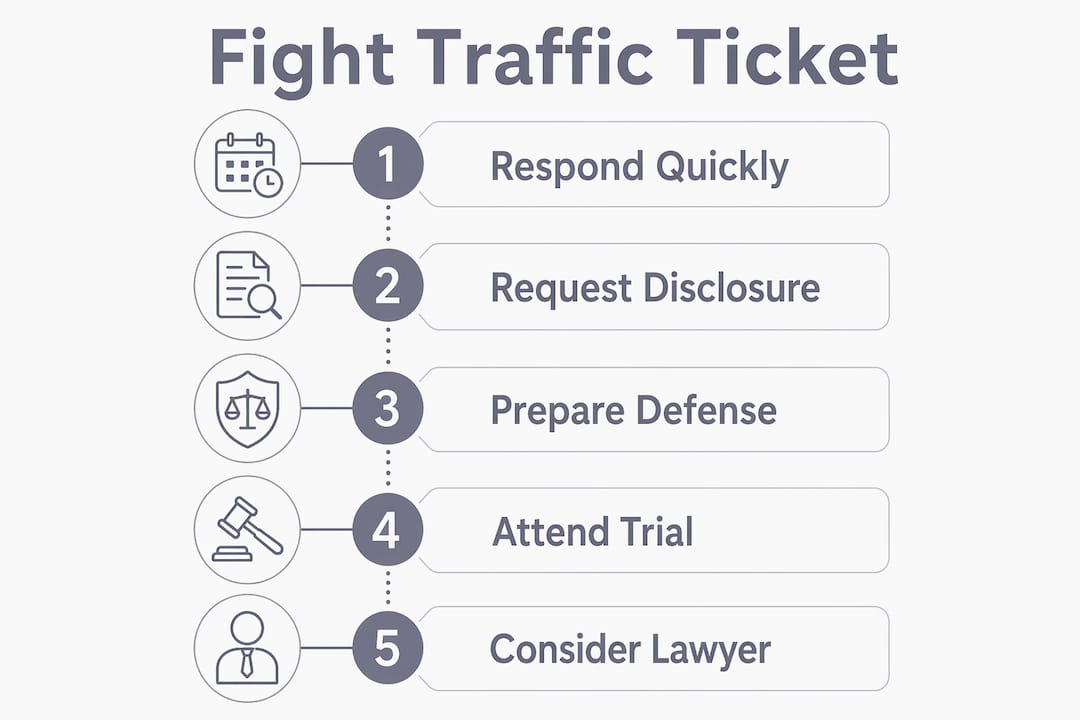
Strong preparation separates drivers who succeed in court from those who do not. Obtaining disclosure is the single most important step. Disclosure is the package of evidence the prosecutor plans to use against you, and it includes the officer's notes, any photos, witness statements, and data from speed or breathalyzer devices.
Request disclosure in writing as soon as you decide to fight the ticket. Send the request to the prosecutor's office listed on your ticket. Once you receive it, review every page carefully. Gaps in the officer's notes, missing calibration records for radar devices, or inconsistencies in the timeline can all support your defense.
Beyond disclosure, gather your own evidence:
- Photos of the scene: Capture road conditions, signage, sight lines, and any relevant markings as soon as possible after the incident.
- Dashcam footage: Download and preserve any video before it overwrites. Label the file with the date and time.
- Witness contact information: If anyone saw the incident, get their name and phone number immediately.
- Your own written account: Write down exactly what happened within 24 hours while the details are fresh.
One of the most persistent myths in Ontario traffic ticket fights is that a small error on the ticket, like a misspelled street name or a wrong vehicle color, will get the charge dismissed. Only critical missing information, such as a missing officer signature or an incorrect offence date, typically qualifies as a fatal flaw. Minor errors rarely invalidate a ticket.
Pro Tip: Request disclosure the same day you decide to fight the ticket. Prosecutors are required to provide it, and delays in receiving it can sometimes work in your favor at trial.
What are the steps for requesting a trial in Ontario?
The formal trial process in Ontario's Provincial Offences Court follows a clear sequence. Understanding each step prevents costly mistakes.
- Request a trial within 15 days. Use the online court case lookup, mail your ticket to the court, or attend the court office in person. Keep a copy of everything you submit.
- Attend your first court appearance. The court will notify you of your first appearance date by mail. This is often an administrative step, not the trial itself.
- Request an Early Resolution meeting. At your first appearance, you can ask to speak with a prosecutor before the trial date. This is optional but often worthwhile.
- Receive your trial date. If no resolution is reached, the court schedules a trial before a justice of the peace.
- Attend the trial. Present your evidence, cross-examine the officer, and make your argument. The prosecutor must prove the charge beyond a reasonable doubt.
- Receive the verdict. The justice of the peace decides whether you are guilty or not guilty. If guilty, you may make submissions about the appropriate fine.
Dress professionally for every court appearance. Address the justice of the peace as "Your Worship." Speak clearly, stay calm, and stick to the facts. Courts respond to organized, respectful presentations.
Pro Tip: If the officer who issued your ticket does not appear at trial, the case is often withdrawn or dismissed. This happens more often than drivers expect, but never count on it as your only strategy.
How do early resolution meetings work in Ontario?
An Early Resolution meeting is a pre-trial conversation between you and a Crown prosecutor. These meetings let drivers discuss charge resolutions before the case goes to a full trial. The goal is to reach an agreement that avoids a lengthy court process.
Potential outcomes from an Early Resolution meeting include:
- Charge withdrawal: The prosecutor drops the charge entirely, often when evidence is weak or disclosure is incomplete.
- Charge reduction: A serious charge is replaced with a lesser offence carrying fewer demerit points or a lower fine.
- Fine reduction: The set fine is lowered without changing the conviction.
- Demerit point reduction: The charge is amended to one that carries fewer points.
The risk of accepting an Early Resolution offer without proper preparation is real. Many ticket cases settle before trial through withdrawal or negotiated plea, but accepting a bad deal early locks you into a conviction you might have beaten at trial. Always review full disclosure before agreeing to any resolution. If you have not received disclosure, ask the prosecutor to adjourn the meeting until you have it.
Early Resolution meetings are available in most Ontario jurisdictions, including Toronto, Brampton, Mississauga, and other Peel Region courts. The process is informal compared to a trial, but the stakes are just as real.
When should you hire legal representation for a traffic ticket?
Legal representation is strongly recommended for any charge that carries a risk of jail time, license suspension, or a significant spike in insurance premiums. These include stunt driving, driving while suspended, driving without insurance, and cell phone charges with prior convictions.
Charges where professional help makes a clear difference:
- Stunt driving: Carries an immediate roadside license suspension and vehicle impoundment. A conviction can result in a license suspension of up to two years.
- Driving while suspended: A criminal-adjacent offence with fines up to $5,000 and possible jail time.
- Driving without insurance: Fines start at $5,000 for a first offence under the Compulsory Automobile Insurance Act.
- Careless driving: Six demerit points and a potential license suspension.
For minor offences like a single speeding ticket or a stop sign violation, self-representation is feasible if you are organized and prepared. The cost-benefit calculation shifts when the charge threatens your license or your livelihood. A traffic ticket lawyer or licensed paralegal who specializes in Ontario Provincial Offences Court knows the local prosecutors, understands disclosure strategy, and can often negotiate outcomes that self-represented drivers cannot reach.
Pro Tip: A free consultation with a traffic ticket specialist costs nothing and tells you immediately whether your case is worth fighting professionally. Use it before your first court appearance.
Key Takeaways
Fighting a traffic ticket in Ontario requires acting within 15 days, requesting full disclosure, and choosing the right strategy before any court appearance.
| Point | Details |
|---|---|
| Respond within 15 days | Failure to respond leads to an automatic conviction without a hearing. |
| Request full disclosure | Officer notes, device data, and photos can reveal weaknesses in the prosecution's case. |
| Know your ticket type | Summons require mandatory court appearances; Provincial Offence Notices offer more response flexibility. |
| Use Early Resolution wisely | Never accept a resolution offer before reviewing disclosure in full. |
| Hire help for serious charges | Stunt driving, suspended driving, and no-insurance charges carry consequences that justify professional defense. |
What I've learned after years of watching drivers fight tickets alone
The single biggest mistake Ontario drivers make is assuming the ticket will "probably go away" or that the officer won't show up. That hope is not a strategy. Officers appear at trial regularly, and courts are not sympathetic to drivers who arrive unprepared.
The second-biggest mistake is treating minor ticket errors as a guaranteed win. Drivers read something online about "fatal flaws" and walk into court expecting dismissal because their street name is spelled wrong. Justices of the peace have seen this argument thousands of times. It rarely works unless the error is genuinely material to the charge.
What actually works is thorough preparation. Request disclosure early. Read every page. Look for gaps in the officer's notes, missing calibration records, or timeline inconsistencies. These are the real pressure points in a prosecution's case. Prosecutors know when their evidence is thin, and a well-prepared driver or representative can use that knowledge to negotiate a better outcome before the trial even starts.
The long-term consequences of a conviction extend well beyond the fine. Insurance rate increases after a conviction can cost drivers thousands of dollars over three to five years. That math changes the value of fighting even a "minor" ticket. Treat every conviction as a financial decision, not just a legal one.
— Maninder
Peeltrafficdefence: fighting Ontario traffic tickets across the province
Receiving a serious traffic ticket in Ontario is not the end of the road. Peeltrafficdefence is a traffic ticket defense law firm based in the Peel Region, serving drivers across all of Ontario. The firm handles stunt driving, cell phone tickets, driving without insurance, and driving while suspended charges, exactly the cases where the stakes are too high to handle alone.

Peeltrafficdefence reviews your disclosure, identifies weaknesses in the prosecution's case, and represents you at every stage of the Provincial Offences Court process. Drivers who work with experienced ticket defense specialists consistently achieve better outcomes than those who navigate the system alone. Read what past clients say on the Peeltrafficdefence testimonials page, then contact Peeltrafficdefence for a case review before your next court date.
FAQ
What happens if I don't respond to a traffic ticket in Ontario?
Failure to respond within 15 days results in an automatic conviction without a hearing. The conviction is registered, demerit points are added, and your insurance company is notified.
Can a small error on my ticket get it dismissed?
Rarely. Only critical missing information such as a missing officer signature or incorrect offence date qualifies as a fatal flaw. Minor spelling errors or wrong vehicle details do not typically invalidate a ticket.
What is an Early Resolution meeting in Ontario?
An Early Resolution meeting is a pre-trial discussion with a Crown prosecutor where you can negotiate a charge reduction, fine reduction, or withdrawal before going to trial. Always request full disclosure before attending one.
Do I need a lawyer to fight a traffic ticket in Ontario?
Legal representation is strongly recommended for serious charges like stunt driving, driving while suspended, or driving without insurance. Minor offences like a single speeding ticket can often be handled through self-representation with proper preparation.
How do I request a trial for an Ontario traffic ticket?
Submit a trial request through the online court case lookup system, by mail, or in person at the court office listed on your ticket. Do this within 15 days of receiving the ticket.